What Made the Ale Sacred?


Near Lake Constance in the early seventh century, the Irish missionary Columbanus came upon a gathering of people with a large vat of beer in their midst. He asked what they intended to do with it. According to his biographer, Jonas of Bobbio, they told him they were making an offering to Wodan. Jonas wrote the story to celebrate a Christian saint’s triumph over pagan worship. What interests me as a Heathen is the moment before the saint intervenes. For a few lines, the people gathered around that beer get to tell us, in their own reported words, whom it was for.
I wish Columbanus had asked a second question. What went into the beer you made for Wodan?
The Land Went Into The Vessel
At Juellinge, on the Danish island of Lolland, a woman was laid in her grave with a long-handled bronze strainer in her right hand. A bronze bucket stood at her head. Both vessels belonged to the kind of service Romans used for wine. Yet an analysis of northern drinking vessels, including hers, reveals a brewing tradition with a distinctly local character. Across four sites in Denmark and Sweden, spanning roughly 1500 BCE to the first century CE, researchers Patrick McGovern, Gretchen Hall, and Armen Mirzoian identified evidence for drinks made in various combinations from grain, honey, berries, and sometimes imported grape wine. Among the botanicals they identified were bog myrtle, yarrow, and juniper. They called this family of fermented drinks “Nordic grog.”
What stays with me is how much somebody had to know before a drink like that could be served. Someone knew where the bog myrtle grew. Someone recognized the right plant, gathered it, and had an idea of what it would do in the brew. As an animist, that changes how I think about the offering. When I picture a horn raised for a good season, I think about the fact that a season had already gone into making it. The grain ripened. The berries came in. Human hands brought those things together. A person could taste something of the land whose continued generosity they were asking for.
The old sources also give us a case in which a plant’s ceremonial purpose is unusually clear. In the Eddic poem Sigrdrífumál, the valkyrie Sigrdrífa teaches Sigurðr about ölrúnar, or ale-runes. Her instructions bring together the horn, the hand that holds it, the blessing spoken over the drink, and a leek cast into the cup. She tells him why he should do this. It is an act of protection against a drink mixed with harm. Here, in a poem interested in precisely what makes a cup spiritually potent, an ordinary leek has work to do. That detail widens the question considerably. A plant could matter to a drinker for reasons that had everything to do with its sacred associations, whether or not it changed how the drinker felt.
Before Hops Became The Familiar Taste Of Beer
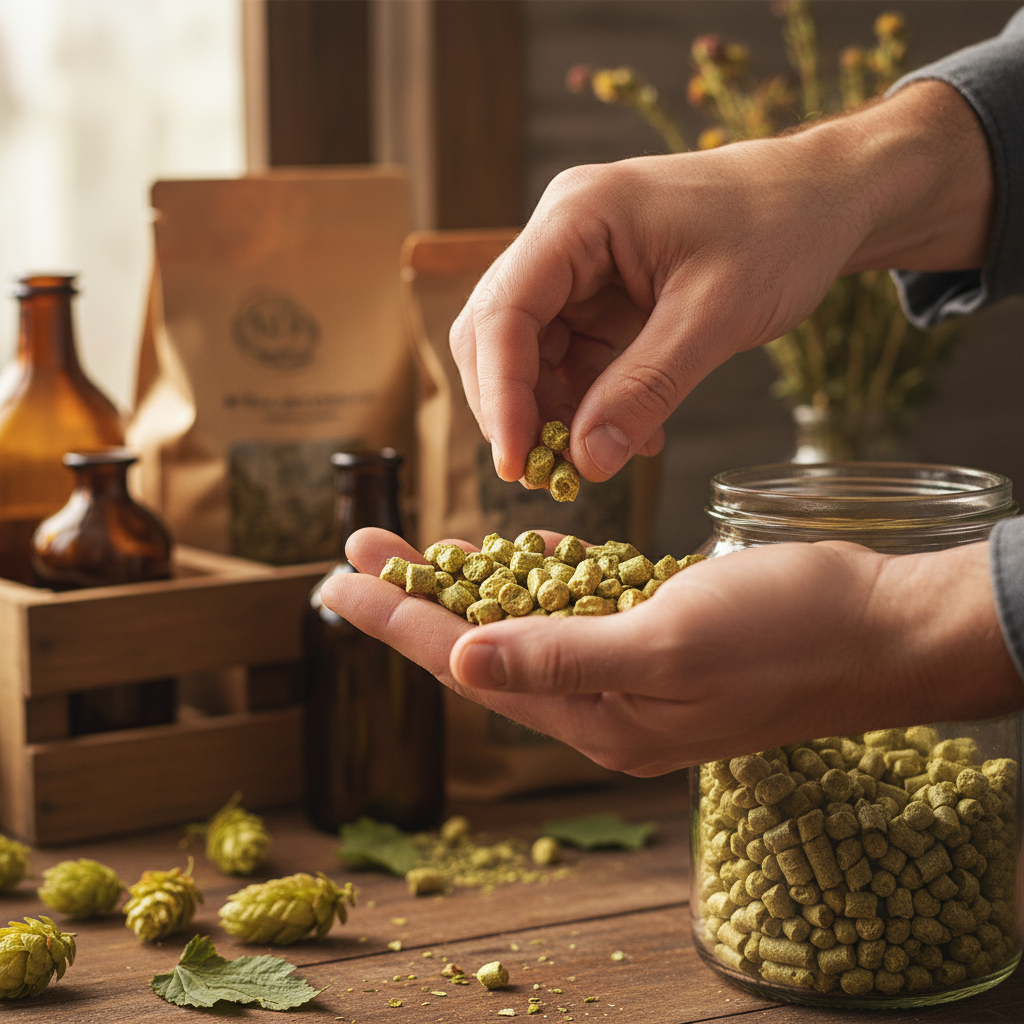
Centuries after the earliest Scandinavian vessels, medieval records from the Low Countries and western Germany give us another word worth knowing. Gruit was a brewing additive whose production and sale could be controlled by whoever held the local rights. Municipal accounts let us see what some gruit houses actually purchased. Bog myrtle, also called sweet gale, appears in those records, as does marsh rosemary. Depending on the place, brewers also used ingredients such as laurel berries and laserwort. The familiar description of gruit as a standard blend of bog myrtle, marsh rosemary, and yarrow smooths out a much more interesting history. Yarrow turns up in the ancient Scandinavian beverage research, yet brewing historian Susan Verberg found it absent from the medieval city accounts she examined. Different brewers in different landscapes made different choices.
Could some of those choices have produced a different kind of intoxication? Verberg takes the possibility seriously. In “The Rise and Fall of Gruit,” she suggests that the effects of certain herbs may have helped recommend them for religious ceremonies and important feasts. Marsh rosemary (Rhododendron tomentosum) does contain biologically active compounds, including the toxic constituent ledol. Some later herbal beers also had a reputation for going to the head and leaving a punishing headache. But a reputation, a chemical analysis of a plant, and an account of a religious experience are three different kinds of evidence. Richard Unger, in Beer in the Middle Ages and the Renaissance, found little basis for concluding that bog-myrtle beer was inherently more intoxicating. We have good reason to take the plants seriously and equally good reason to be precise about which plant and which effect we mean.
Hops entered this history gradually. The monastery of Corbie in northern France left a brewing reference to hops in 822 CE. By the fourteenth century, Hamburg was exporting substantial quantities of hopped beer to the Netherlands. Beer that kept well enough to travel had an obvious advantage for merchants. Meanwhile, people with income tied to gruit had good reason to defend the older trade. That chronology leaves little room for the popular story that Protestant reformers introduced hops to suppress a visionary pagan drink. Hopped beer was already crossing borders generations before the Reformation. What the records show is a long change in trade, taste, and brewing practice. What they cannot tell us is that hops closed a door to the gods.
Henbane And The Limits Of What Survives
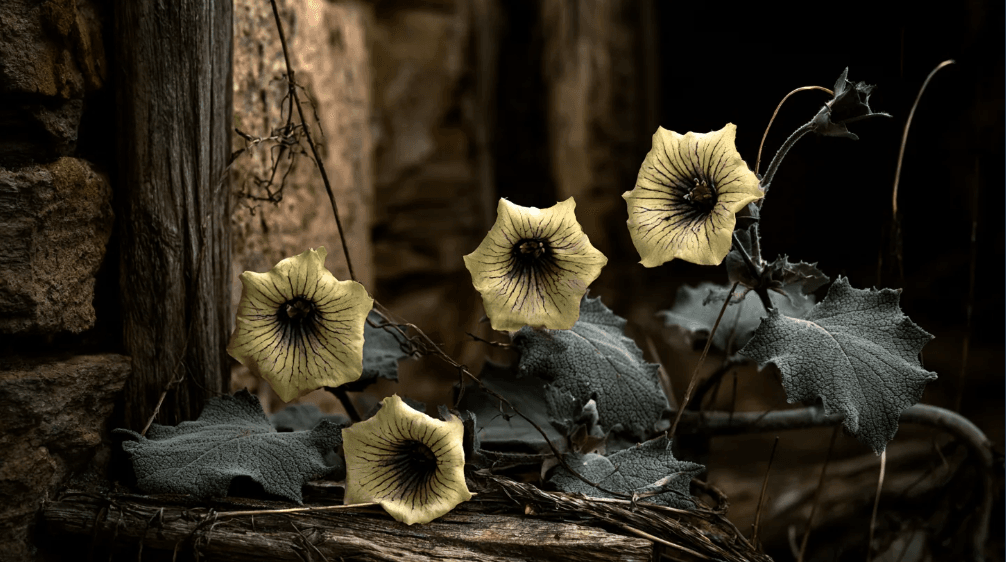
Henbane makes the possibility of a deliberately mind-altering drink harder to dismiss. At Fyrkat in Denmark, a woman buried around 980 CE had black henbane seeds, probably carried in a leather purse. A metal object interpreted as a ritual staff was among her grave goods. Those finds helped give rise to the interpretation that she was a vǫlva, a seeress, and that the seeds may have had a place in her practice. Henbane can produce hallucinations and dangerous poisoning. We know the seeds were there. How she understood them, administered them, or experienced their effects went to the grave with her.
Across the North Sea, an Old English medical text supplies the detail missing from Fyrkat. As Max Nelson discusses in The Barbarian’s Beverage, a late tenth- or early eleventh-century preparation explicitly puts henbane and other plants into ale. The writer even names the intended result. It was a sleep-drink. So when someone asks whether people in early medieval northern Europe ever put henbane in ale, the answer is yes. When someone asks whether a Scandinavian seeress drank henbane ale to seek a vision, we have a pouch of seeds in one country and a medicinal use in another. The surviving evidence leaves that last distance for us to cross in our imaginations.
I believe some people who understood these plants well enough to make medicines may also have explored their place in ceremony. I can hold that belief without claiming to know what the woman at Fyrkat did. In fact, I owe her that much. She was a person with knowledge and intentions of her own. Her grave gives me a glimpse of what she carried and very little authority to speak for her.
Three Runes On A Stone
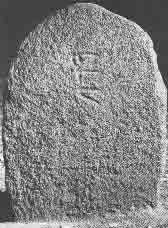
Then there is ᚨᛚᚢ. On the Elgesem stone, found in a burial mound in Norway, those three runes make up the entire surviving inscription. Alu. No sentence around it. No directions for its use. Someone judged that the word could stand alone, and that is how it has come down to us.
Runologist Tineke Looijenga accepts “ale” as its literal meaning while acknowledging how uncertain its function remains on objects such as amulets. Among the interpretations she discusses are magic, ecstasy, and intoxicating drink. Mindy MacLeod and Bernard Mees question whether the inscription refers to ale at all and favor an association with dedication or veneration. That disagreement matters. Consecration, protection, and ecstatic inspiration are possible associations people have argued for. Giving all three as settled translations would put considerably more on the stone than its carver left us.
Here is where I land as a Heathen. If the carver understood alu as ale, I wonder whether the name of the drink could call to mind an act performed with it. I think of how much we mean today when we say we will raise a glass to someone. Those few words can hold gratitude, grief, admiration, and the memory of the last time we sat at a table together. A person unfamiliar with the custom could identify the vessel correctly and still miss nearly everything being said. Perhaps alu carried that kind of weight for some of the people who carved it. I can imagine an herbal ceremonial drink contributing to those associations. I cannot look at those three runes and tell you what was in the brewer’s kettle.
What Óðinn Says About Losing Your Wits
In Hákonar saga góða, Snorri Sturluson recounts a Norwegian sacrificial feast where the farmers bring ale and the host blesses the cups. The drinking has an order and a purpose. A cup is raised to Óðinn for victory, others to Njǫrðr and Freyr for peace and a good season. The dead are remembered in memorial toasts. Snorri wrote in the thirteenth century about people who lived in the tenth, a distance worth keeping in mind. What his account preserves especially well is the sense of obligation in the room. When a cup came round, there was someone to honor and something the people hoped would follow from honoring them.
And what if the person holding that cup kept drinking? The Hávamál gives the question to Óðinn himself. In stanzas 12–14, he speaks of the bird of forgetfulness hanging over the drinking feast, stealing away a person’s awareness. Then he makes the warning personal. He remembers being overcome by drink and speaks of the value of coming away with one’s mind restored. I find that admission more persuasive than a rule about how much anyone is allowed to drink. The god whose counsel I am reading knows what it is to have had enough and then gone on.
That matters to how I understand divine inspiration. If I raise a horn to my father, I want enough presence of mind to tell a story about him and enough attention to hear what somebody else remembers. If I speak a promise before my community, the people who hear it have every right to expect I will remember it tomorrow. And if something moves me during a rite, I owe that experience the patience to sit with it again in the morning. The intensity of what I felt cannot, on its own, tell me where it came from or what I ought to do about it.
I believe there were old ales whose herbs changed the experience of drinking them. I think it entirely possible that some people welcomed that change as part of an encounter with the sacred. I also believe a person can pour the whole offering onto the earth, walk home sober, and have participated fully in the rite. The account from Bregenz leaves us no description of a vision and no record of how the beer tasted. What survived was the answer those people gave when a stranger asked about the vat they had gathered around.
It was for Wodan.
Sources and further reading
- Jonas of Bobbio. The Life of St. Columban, §53, translated by Dana Carleton Munro.
- Snorri Sturluson. “The Saga of Hákon the Good,”
- “Hávamál,” stanzas 12–14. [Bellows translation]
- “Sigrdrífumál,” the ale-runes passage.
- The Elgesem stone, Vestfold, Norway.
- Tacitus. Germania, §§22–23, ca. 98 CE.
- McGovern, Patrick E., Gretchen R. Hall, and Armen Mirzoian. “A Biomolecular Archaeological Approach to ‘Nordic Grog.’” Danish Journal of Archaeology 2, no. 2 (2013), 112–131.
- Behre, Karl-Ernst. “The History of Beer Additives in Europe—A Review.” Vegetation History and Archaeobotany 8 (1999), 35–48.
- Verberg, Susan. “The Rise and Fall of Gruit.” Brewery History 174 (2018), 46–79.
- Unger, Richard W. Beer in the Middle Ages and the Renaissance. University of Pennsylvania Press, 2004.
- Oliver, Garrett, ed. The Oxford Companion to Beer. Oxford University Press, 2011.
- Groot, Maaike, Martijn van Haasteren, and Laura I. Kooistra. “Evidence of the Intentional Use of Black Henbane (Hyoscyamus niger) in the Roman Netherlands.” Antiquity 98, no. 398 (2024), 470–485.
- Nelson, Max. The Barbarian’s Beverage: A History of Beer in Ancient Europe. Routledge, 2005.